
Off the coast of Tobermory, Ontario, sits an island of rugged shoreline and impressive scenery: Flowerpot Island. The island resides in Five Fathom National Marine Park in the traditional territory of the Saugeen Ojibway Nation. The island bears a high level of cultural significance. Local Indigenous groups and volunteer communities work together to protect the island’s ecological and historical integrity.

Mayer, Joshua. (2023). Dwarf Lake Iris Photo. Tip of the Mitt Watershed Council. https://watershedcouncil.org/mural/dwarf-lake-iris/
There are several notable landmarks and ecological features across the island that visitors can experience. Visitors can admire the Big Tub Lighthouse and rare, native wildflower species like the Dwarf Lake Iris or Lakeside Daisy. Nonetheless, the Island’s namesake stems from a unique geological feature that leaves visitors in awe. Flowerpot Island’s iconic “Flowerpots” are pillars of rock on the South-Eastern coast. These rocks stand on a thin pillar that expands to a wide-brimmed top like a giant-sized terracotta flowerpot.
Science Behind the Island’s “Flowerpots”
These geological formations leave many visitors with one question: how do they form? The “flowerpots” are a coastal landform referred to formally as sea stacks. Sea stacks resulted from centuries long battles between coastal headlands that prodded off the island and incoming lake waves.
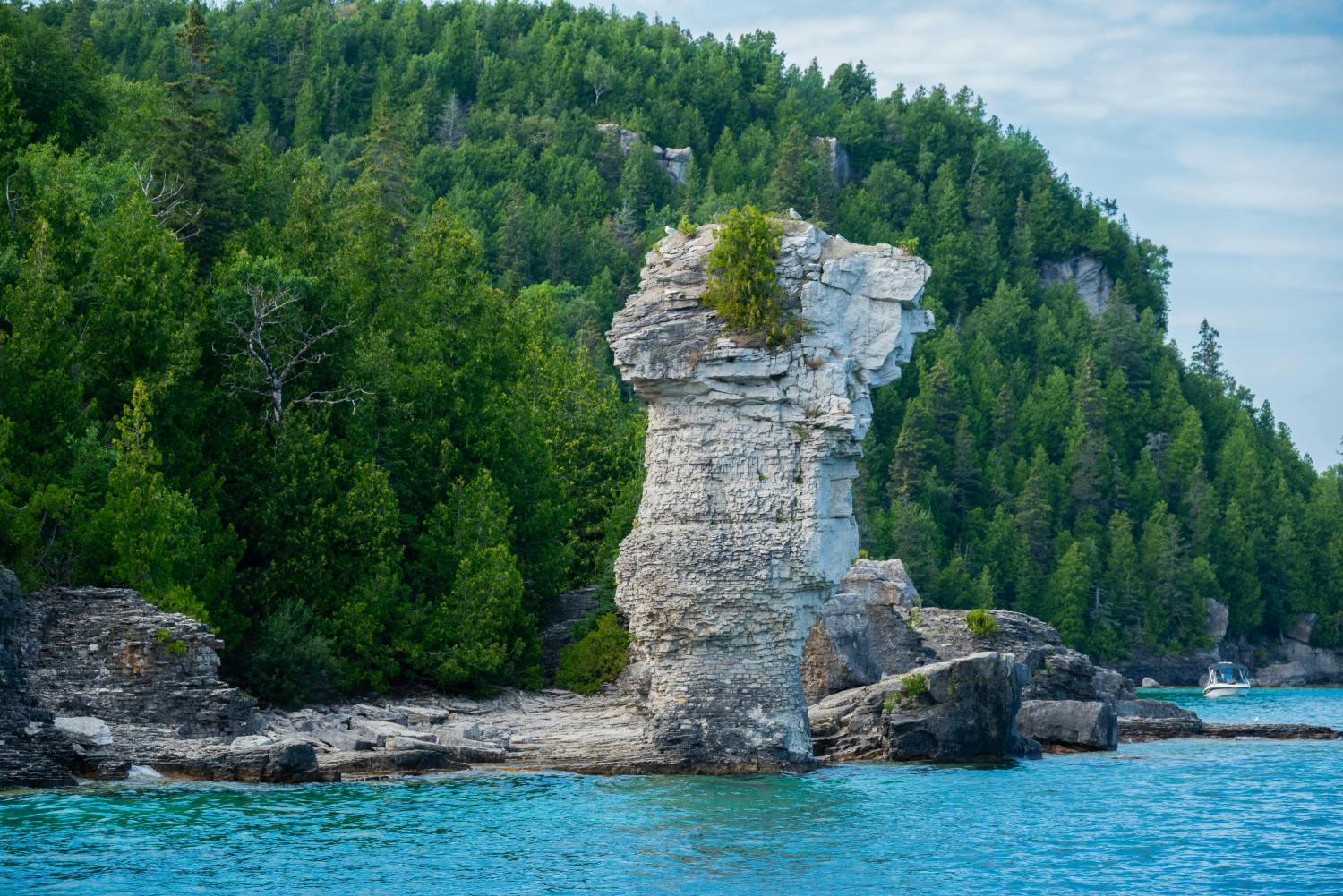
Cascading waves from Georgian Bay attacked the headlands and weathered away the softer limestone in the cliffside. Erosion is the process of water stripping away rocks and soil from landforms. This eventually cracks the cliff which then erodes into a cave. Once the cave’s interior erodes enough to reveal the headland’s other side, the water forms an archway. Water passes through, erodes and widens the archway until it can no longer support the weight of the arch’s roof. Once the roof collapses, the detached pillar of the archway stands off the coast and becomes sea stacks. These sea stacks serve as important habitat features for coastal bird nesting sites.
Tourism and Its Impacts
Flowerpot Island encourages environmental appreciation as visitors learn about human history and explore its geological wonders. In 2017, the island attracted around 123,849 visitors for hiking, rock climbing and camping alike. In response to surging visitors, Parks Canada introduced a capacity limit of 650 people on the island at a time. They also developed and repaired their current infrastructure to support visitors through the following ways:
- Building new arrival and departure docks at Beachy Cove for transport to the island.
- Developing new composting toilets near the Light Station.
- Resurfacing the trail from Beachy Cove to the Light Station.
- Replacing the stairways to various island caves.
Sustainable Tourism on the Island
Many fans of the islands might wonder if these infrastructural changes will increase the capacity limit of visitors. Nonetheless, the park visitor experience is not the sole consideration behind the capacity limit. Parks Canada maintains that this capacity is an example of what sustainable tourism can look like during environmental explorations.

Parks Canada. (n.d.). Geology. Government of Canada. https://parks.canada.ca/amnc-nmca/on/fathomfive/nature/geologie-geology
When a park lacks enough infrastructure to support human visitors, our ecosystems and cultural history can suffer. Even small disruptions to these ecosystems can threaten the delicate interactions between the biotic life on the island. For example, increased tourism can make it harder to access trails, enticing hikers to walk in non-designated hiking paths. This could disturb soil around dormant plant species like the Nodding Trillium and impact its ability to regrow in spring. Increased foot traffic around sea stacks can also prevent sea birds from nesting due to repeated disruptions from visitors.
How to Be a Supportive Park Visitor
Parks Canada appropriately identifies us as the root cause of habitat degradation. It is our responsibility to hold ourselves accountable while visiting these significant landmarks. If you plan on visiting Flowerpot Island, follow the tips below to make sure you’re a steward of the land:
- Research the wildlife and vegetation you can expect on your venture and identify some threats to their survival.
- Take your garbage with you until you can properly dispose of it at park waste facilities.
- Stay on marked official trails to avoid disrupting unseen habitats and plant interactions.
- Clean your boots before and after leaving the park. You can do this either at home with a brush or at a boot wiping station. This helps ensure that you do not take harmful invasive seeds with you.
- Pay attention to trail and amenities signs. Follow the rules stated.
- Don’t fly drones throughout parks or trails. These disturb wildlife, especially aviary species.
- Try not to leave marks on important geological features (i.e., chalk, graffiti).
Check out this link to the Parks Canada website to find more information on park safety and respect for wildlife.
References
- Parks Canada. (2020). Flowerpot Island Visitor Use Management Plan. Parks Canada Agency http://parkscanadahistory.com/publications/fathomfive/vum-flowerpot-is-e-2020.pdf
- Friends of the Bruce. (n.d.). Flowerpot Island. Friends of the Bruce District Parks https://friendsofthebruce.ca/supported-projects/#light-station
- Bruce Anchor Cruises. (n.d.). Flowerpot Island. The Bruce Anchor
https://cruises.bruceanchor.com/flowerpot-island-cruise/ - Kwak-Hefferan, Elisabeth. (2022). Sea Stacks on Olympic National Park’s Coast. Olympic National Park Trips https://www.myolympicpark.com/things-to-do/natural-wonders/sea-stacks/
- Parks Canada. (2024). Top tips to respect wildlife and stay safe. Government of Canada. https://parks.canada.ca/voyage-travel/conseils-tips/faune-wildlife
About the Author
Meghan is a graduate from McMaster University with a Bachelor’s of Science in Honours Environmental Science with a passion for aquatic and terrestrial restoration. She is currently dedicating her work to Conservation Authorities, where she hopes to support conservation of aquatic habitats, and empower communities to engage with their local environments.
 SCIFAA