
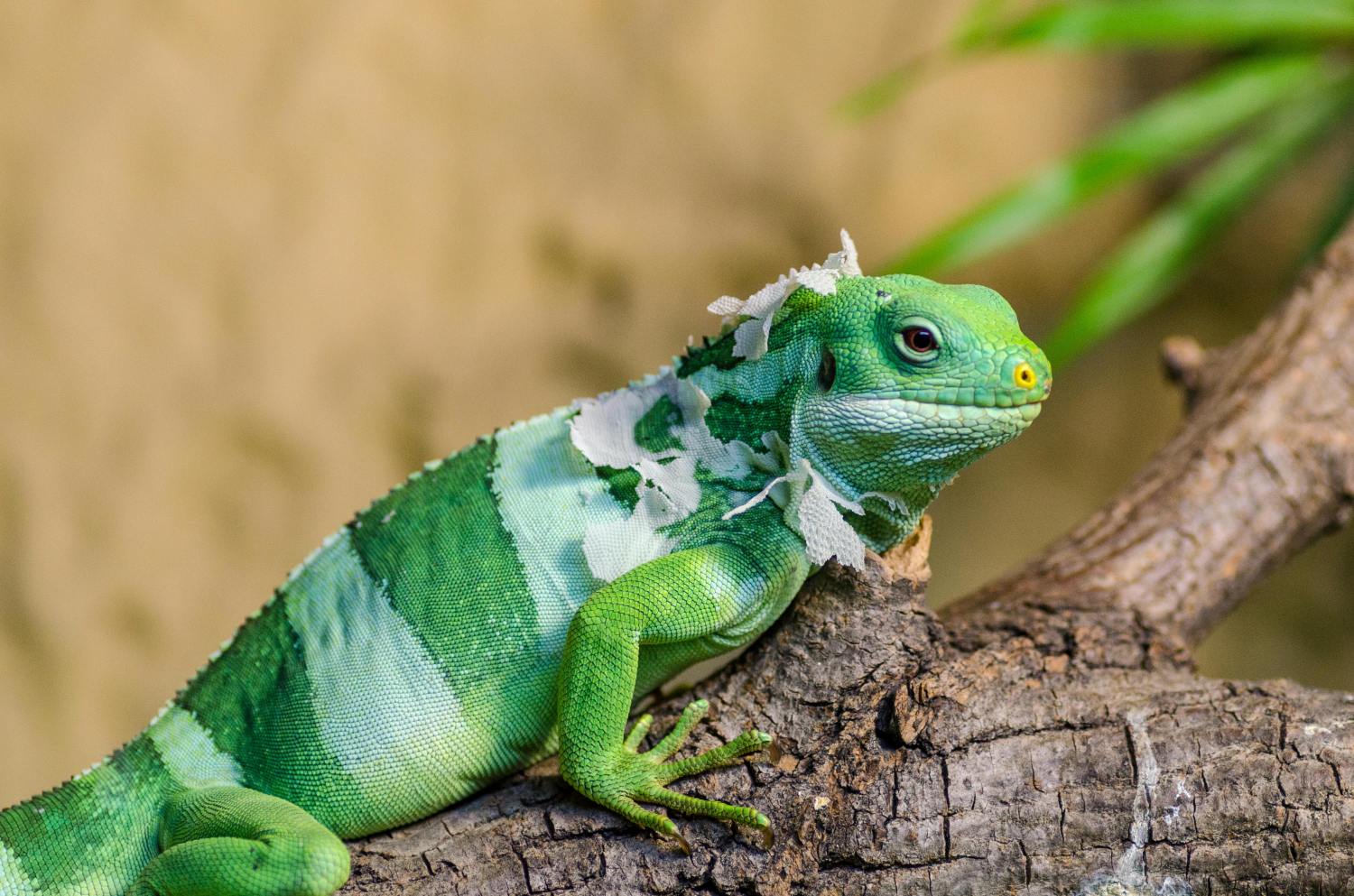
1. What is the name of the heaviest lizard species in the world, found on select Indonesian islands?
Answer: the Komodo dragon. It also has a venomous bite.
2. Adult Komodo dragons can consume up to what percentage of their own body weight in one meal?
Answer: up to 80%!
3. True or false: Komodo dragons are cannibalistic.
Answer: true. Komodo dragons have a carnivorous diet but adult dragons might also feast on recently hatched dragons!
4. What percentage of the world’s ~3000 snake species are venomous?
Answer: around 10-15%.
5. What is the name of the longest venomous snake in the world?
Answer: the king cobra. It has a venom powerful enough to kill an elephant in only a few hours!
6. Which snake species is thought to be responsible for the most human deaths?
Answer: the saw-scaled viper. Although the venom is only lethal in less than 10% of untreated cases, these snakes tend to bite frequently and early.
7. What is the fatality rate of a Black Mamba snake bite if left untreated?
Answer: 100%. The Black Mamba is the deadliest snake in Africa.
8. Which snake is believed to have the most powerful venom of all snakes?
Answer: the Inland Taipan. One bite could kill one hundred humans, and contains a mixture of myotoxins, neurotoxins, and procoagulants.
9. How many different species of marine turtles exist?
Answer: seven. These include the Hawksbill, Loggerhead, Leatherback, Olive ridley, Green, Flatback, and Kemp’s ridley.
10. Which country holds the title for discovering the largest marine turtle?
Answer: Wales. Researchers discovered a leatherback sea turtle in 1988 that weighed 900kg!
11. True or false: turtles don’t have teeth.
Answer: true. Instead, they have beak-like mouths that consist of keratin, which help them grasp food.
12. How many bones (fused together) make up a turtle’s shell?
Answer: over 50!
13. What is the longest migration distance (in miles) ever recorded by a marine turtle?
Answer: 13,000 miles. A female leatherback turtle travelled this distance across 647 days, travelling from Indonesia to west coast United States.
14. Which island nation has the most chameleons in the world?
Answer: Madagascar. It’s home to around 50% of all ~200 chameleon species.
15. What do you call the pigment containing cells that allow chameleons to change colour?
Answer: chromatophores. Different types of chromatophores have different types of pigments (e.g., black, yellow-red, etc.).
16. A chameleon can extend its tongue how many times its own body length to catch insects?
Answer: 2.5 times. It can also unravel its tongue at a speed equivalent to a car accelerating at 60 mph in 0.01 seconds!
17. The word “chameleon” is derived from Greek terminology and translates in English to mean…?
Answer: earth lion. The word “chamai” means on the earth or on the ground, and “leon” means lion.
18. True or false: a chameleon’s main purpose for changing colour is to blend in with its surroundings (i.e., camouflage).
Answer: false. Chameleons do sometimes change colour to camouflage but there are usually more important reasons. For example, they can change colour to reflect their moods (i.e., turn green or brown when relaxed) or to show submission to species that view them as a threat.
19. How many different teeth can an alligator go through in a lifetime?
Answer: 3000 teeth! Alligator teeth are replaced as they become worn down.
20. What is the average size (in feet) of a male, adult American Alligator?
Answer: 11.2 feet. Female adults average 8.2 feet in size.
21. Alligators primarily live in which type of water: freshwater or saltwater?
Answer: freshwater. Alligators can tolerate short-term exposure to saltwater (i.e., hours or a few days). Nonetheless, they mostly roam in lakes, rivers, swamps, and other freshwater areas.
22. Which are considered more aggressive: crocodiles or alligators?
Answer: crocodiles. That being said, you should still avoid contact with both creatures!
23. Crocodiles and alligators differ in colour. Crocodiles tend to be olive or tan whereas alligators are what colour(s)?
Answer: grey or black.
24. Snout shape differs between crocodiles and alligators. Alligator snouts are U-shaped whereas crocodiles snouts are shaped like which letter?
Answer: the letter V. Alligators also have broader snouts whereas crocodile snouts are narrower.
25. How many alligators are estimated to live in the wild in Southeastern United States?
Answer: 5 million! Much of these alligators live in the state of Louisiana.
About the Author
Yasmin is a McMaster University graduate and Program Coordinator at SCIFAA. She holds a Bachelor of Applied Science in Sustainable Chemistry and a Minor in Environmental Sciences.
 SCIFAA