
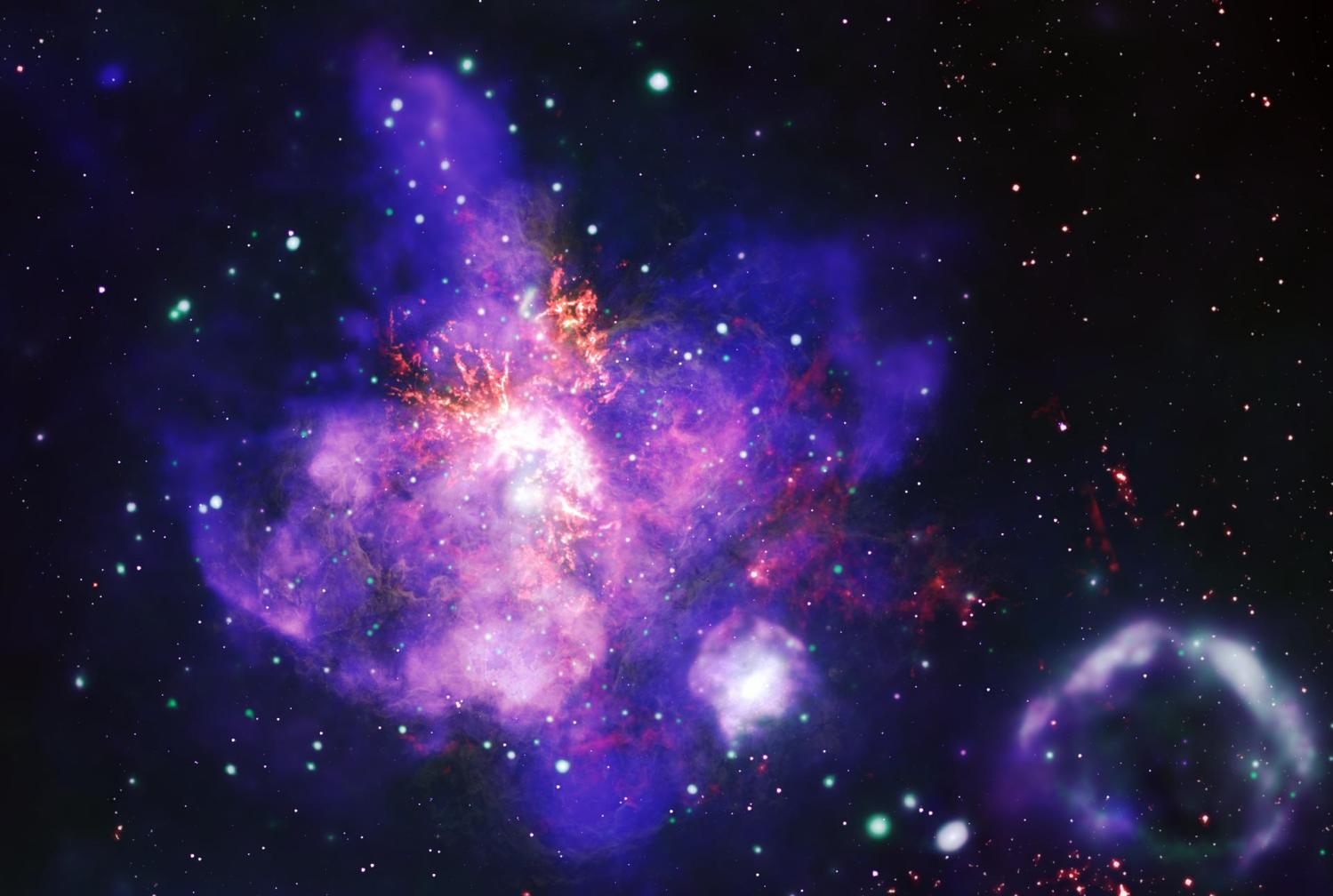
Image credit: X-ray: NASA/CXC/Penn State Univ./L. Townsley et al.; Infrared: NASA/JPL-CalTech/SST; Optical: NASA/STScI/HST; Radio: ESO/NAOJ/NRAO/ALMA; Image Processing: NASA/CXC/SAO/J. Schmidt, N. Wolk, K. Arcand
1. Which planet in the solar system is the closest to the sun?
Answer: Mercury.
2. Which planet in the solar system is the furthest from the sun?
Answer: Neptune.
3. Which planet in the solar system is called the “red planet?”
Answer: Mars.
4. True or False: the sun is a star.
Answer: True.
5. What is the name of the tallest mountain in the solar system?
Answer: Olympus Mons. It’s found on Mars!
6. What are the names of Mars’ two moons?
Answer: Phobos and Deimos.
7. Which chemical is responsible for Mars’ red colour?
Answer: Iron oxide (aka rust).
8. Which is the hottest planet in the solar system?
Answer: Venus.
9. Which planet in the solar system has the most moons?
Answer: Saturn (146 moons according to NASA).
10. Which four planets in the solar system are the “gas giants?”
Answer: Jupiter, Saturn, Uranus, and Neptune.
11. How often does the planet Mercury revolve around the sun?
Answer: every 88 Earth days.
12. Which two planets in the solar system do not have any moons?
Answer: Mercury and Venus.
13. Which is the smallest planet in the solar system?
Answer: Mercury.
14. Which planet in the solar system is called Earth’s “twin” because of similarities in size?
Answer: Venus.
15. Which element mostly makes up Earth’s atmosphere?
Answer: Nitrogen.
16. Which planet in the solar system has a valley 10 times longer than the Grand Canyon?
Answer: Mars.
17. What colour are sunsets on the planet Mars?
Answer: Blue.
18. Which planet in the solar system experiences the shortest day?
Answer: Jupiter. One day lasts 9.9 hours.
19. What is the name of the largest moon in the solar system?
Answer: Ganymede. It belongs to Jupiter.
20. Which planet in the solar system has the most volcanoes?
Answer: Venus. It has 1600+ volcanoes!
21. Which chemical is responsible for Uranus’ blue-green colour?
Answer: Methane.
22. What are the four innermost planets in the solar system?
Answer: Mercury, Venus, Earth, and Mars.
23. Which planet would be able to float on water?
Answer: Saturn. Saturn primarily consists of gas.
24. “Astronaut” originates from the Greek language and translates in English to…?
Answer: Star sailor.
25. True or false: Mercury does not have an atmosphere.
Answer: True. Instead, Mercury has an exosphere.
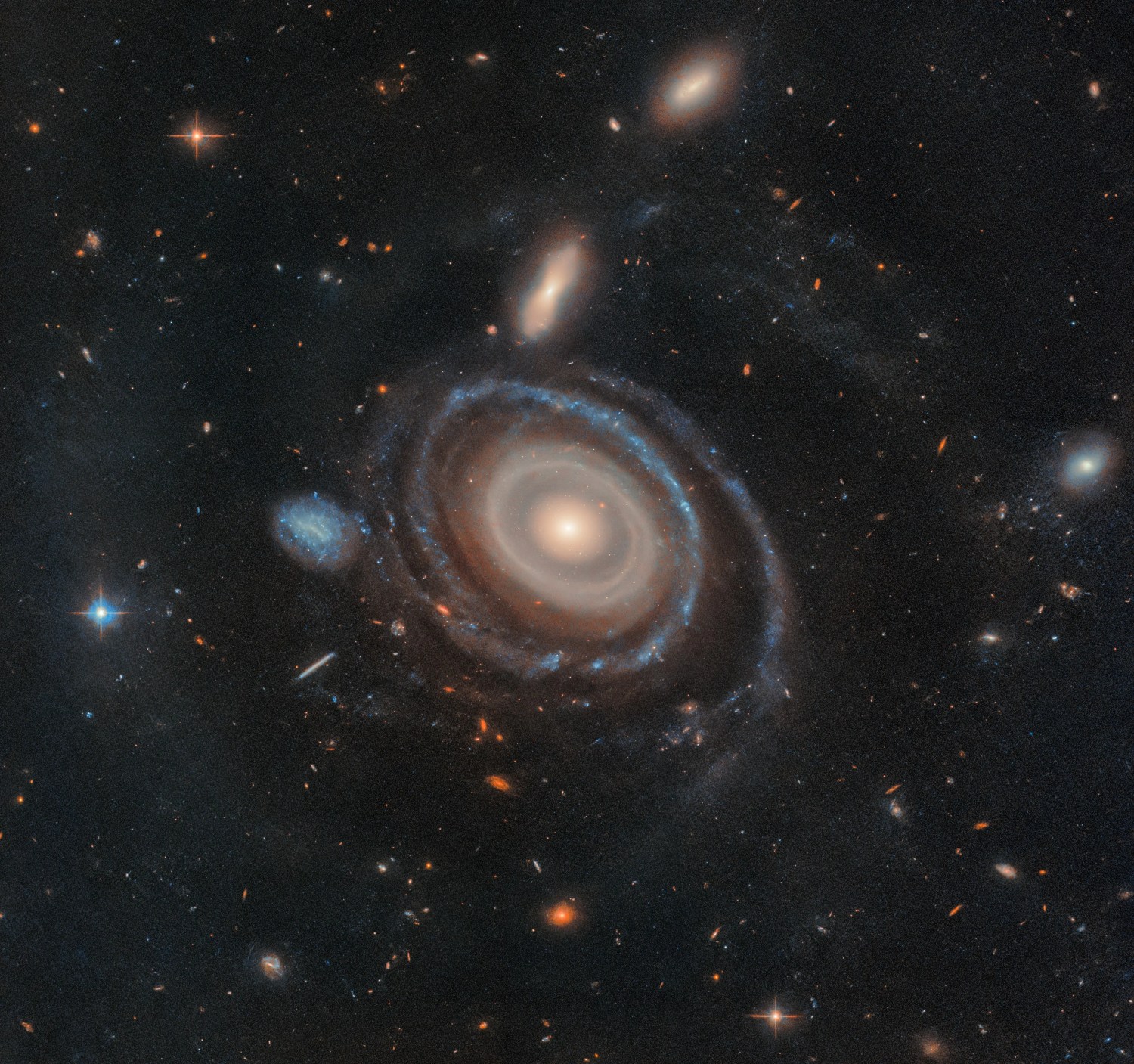
Image credit: NASA, ESA, Imad Pasha (Yale), Pieter van Dokkum (Yale)
26. What is the “Great Red Spot” found on Jupiter?
Answer: a huge anticyclonic storm going on for over 300 years.
27. What are the names of the five dwarf planets in the solar system?
Answer: Ceres, Pluto, Haumea, Makemake, and Eris.
28. What is the name of the phenomenon where the moon passes in front of the sun?
Answer: a solar eclipse.
29. How many phases of the moon are there?
Answer: Eight phases.
30. What is the name of the phenomenon where the sun passes in front of the moon?
Answer: a lunar eclipse.
31. What is the name of the first person to walk on the moon?
Answer: Neil Armstrong.
32. How many planet Earths could fit inside the sun?
Answer: Around 1.3 million!
33. What two elements make up the sun?
Answer: Hydrogen and helium.
34. True or false: light can escape from a black hole.
Answer: False. Not even light can escape from a black hole!
35. What is the coldest planet?
Answer: Uranus. Some parts of Uranus are actually colder than Neptune!
36. How much does a teaspoon of a neutron star weigh in tons?
Answer: 10 million tons.
37. Which planet in the solar system spins backwards?
Answer: Venus.
38. Which is the biggest planet in the solar system?
Answer: Jupiter.
39. True or False: the sun is the biggest star in the solar system.
Answer: False. There are stars in the solar system that are 100 times bigger than the sun!
40. The sun contains what percentage of all material found in the solar system?
Answer: 99%. The remaining 1% of material consists of asteroids, planets, comets, etc.
41. What two materials make up comets?
Answer: dust and ice.
42. True or False: Saturn is the only planet that has rings.
Answer: False. Jupiter, Uranus, and Neptune also have rings.
43. What year did we stop considering Pluto a planet?
Answer: 2006. The International Astronomical Union (IAU) changed the status of Pluto to a “dwarf planet” in August of 2006.
44. How many hours does it take for Earth to complete a rotation?
Answer: 24 hours.
45. What is the scientific name for shooting stars?
Answer: Meteors.
46. True or False: Asteroids are bigger than meteors.
Answer: True.
47. How many days does it take for the Earth to complete a revolution around the sun?
Answer: 365.25 days. One calendar year lasts 365 days but we add up the remaining 0.25 days to get a leap year (366 days) every four years!
48. The three big categories of galaxies are irregular, elliptical, and…?
Answer: Spiral.
49. How many stars are in the Milky Way?
Answer: Over 100 billion!
50. Which astronomer’s model of the universe incorrectly placed Earth at the center?
Answer: Ptolemy. He designed the geocentric model of the universe.
About the Author
Yasmin is a McMaster University graduate and Program Coordinator at SCIFAA. She holds a Bachelor of Applied Science in Sustainable Chemistry and a Minor in Environmental Sciences.
 SCIFAA