
Background and Introduction
The industrialization of Hamilton Harbour is responsible for several local health and environmental impacts, across history and modern times.1,2 Pollutants released from steel plants in the industrial sector negatively impact air and water quality.3,4 These impacts strongly correlate with rates of prevalent illnesses in Hamilton, Ontario.3,4 Emerging policy shifts, scientific research, and public pressure continue to motivate a shift towards more sustainable energy sources.5,6 There are clear correlations between Hamilton Harbour’s development, and adverse health and environmental impacts. Nonetheless, a sequential, accessible presentation of these key findings is unavailable to the scientific community and the public.
Methods
We used historical methodologies to analyze the historical and contemporary, health and environmental repercussions of Hamilton’s steel industry. To research temporal and spatial information about our topic, we used scientific articles retrieved from online academic search engines. We also used public health and government resources, as well as environmental data sets and GIS mapping tools. Also, we used archives from the Government of Canada, CBC News, and Hamilton Public Library. These resources allowed us to combine visual, oral, and contextual histories and explore connections between personal narratives and statistical data. We presented our findings in an interactive online timeline on a website we created (Figure 1). To visit the website and explore the complete timeline, please visit the link at the bottom of this page. The website includes simple texts, quotes, photos, graphs, and audio files to increase content accessibility.
Findings
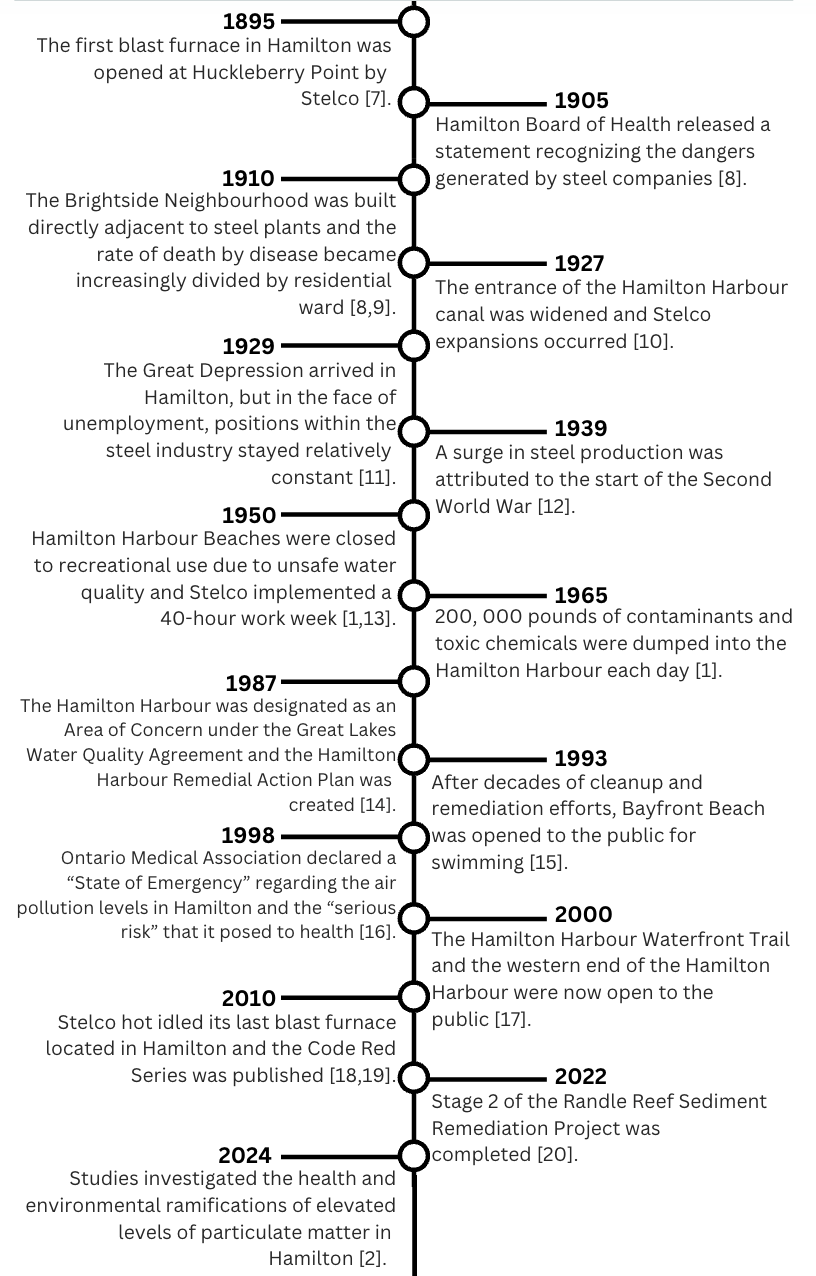
Figure 1. Summary of the interactive timeline presented on the project website. The timeline includes descriptions of key events which happened regarding the Hamilton Harbour between 1895 and 2024.
Attitudes towards Hamilton’s steel industry shifted as the negative implications become more obvious.16,21 People became less dependent on the industry for their livelihood.16,21 Historical and modern industrial activity continues to impact Hamilton air and water quality.3,4 Environmental impacts contribute to several health effects, worsened for residents living close to the industrial sites.4,22 Recent collaborative environmental and health remediation efforts and public involvement are hoping to help.5,6 These projects aim to improve air and water quality in Hamilton.5,6 People have a personal understanding of air and water quality, including the impacts on health and the enviornment.16 Visible signs of pollution and lived experiences highly contribute to this understanding.16
Limitations of Current Research
Across our research, we found several articles and reports on the current health and environmental impacts of Hamilton’s steel industry. Nonetheless, this did not usually include chronological information of information of an accessible style to the public. Also, there are extremely limited recorded data sets on environmental impacts in Hamilton in the 1800s and early 1900s. This makes exact statistical comparisons unfeasible. Also, as a whole, the available historical and contemporary content lacked combination of both social and scientific views. This fails to recognize the interdisciplinary nature of the steel industry’s implications.
Timeline Website
Click the link below to explore the interactive timeline:
https://sadiepgilliland.wixsite.com/hamiltonharbour

References
1Giglia SN. From Man vs. Nature to Environment vs. Budget – The Shifting Battles in the History of Pollution and Toxicity in Hamilton Harbour. 2015;3(1). https://scholar.uwindsor.ca/cgi/viewcontent.cgi?article=1030&context=gljuh
2Yassine MM, Dabek-Zlotorzynska E, Celo V, Sofowote UM, Mooibroek D, Hopke PK. Effect of industrialization on the differences in sources and composition of ambient PM2.5 in two Southern Ontario locations. Environmental Pollution. 2024;341:123007. doi:10.1016/j.envpol.2023.123007
3Clean Air Hamilton. Health Impacts. Hamilton Public Services. Published 2024. https://cleanairhamilton.ca/health-impacts/
4U.S. Environmental Protection Agency. Health and Environmental Effects of Particulate Matter (PM). United States Government. Published 2023.
5Environment and Climate Change Canada. Maps of reporting facilities – virtual globe format. Government of Canada. Published 2024. https://data-donnees.az.ec.gc.ca/data/substances/plansreports/map-of-reporting-facilities-geo database/maps-of-reporting-facilities-virtual-globe-format/?lang=en
6Bay Area Restoration Council. Randle Reef. Bay Area Restoration Council. Published 2024. https://www.randlereef.ca/
7Loschiavo MA. Stelco’s Lake Erie Works. Published April 1984. https://macsphere.mcmaster.ca/bitstream/11375/18710/1/Loschiavo_Micheal_A_1984_Geo4C 6.pdf
8Gagan RR. Disease, Mortality and Public Health, 1900-1914. 1981. https://macsphere.mcmaster.ca/bitstream/11375/10496/1/fulltext.pdf
9Hamilton Civic Museums. The Brightside Neighbourhood. Hamilton Civic Museums. Published 2024. Accessed March 24, 2024. https://hamiltoncivicmuseums.ca/exhibition/brightside/
10Hamilton Port Authority Staff. Port of Hamilton Celebrates 100 Years: 1912-2012.; 2015. https://www.hopaports.ca/wp-content/uploads/2015/09/Port-of-Hamilton-Celebrates-100-Year s-_-book.pdf
11Zivin K, Paczkowski M, Galea S. Economic downturns and population mental health: research findings, gaps, challenges and priorities. Psychol Med. 2011;41(7):1343-1348. doi:10.1017/S003329171000173X
12The Hamilton Spectator. Industry Here Feels Stimulus of War Orders. The Hamilton Spectator.https://collections.warmuseum.ca/warclip/objects/common/webmedia.php?irn=5050115. Published October 20, 1939.
13United Steel Workers. Our history. USW Canada. Accessed March 28, 2024. https://usw.ca/our-history/
14Environment and Climate Change Canada. Randle Reef: Hamilton Harbour Area of Concern. Government of Canada. Published 2023. https://www.canada.ca/en/environment-climate-change/services/great-lakes-protection/areas concern/hamilton-harbour/randle-reef.html
15Craggs S. 25 years later, Bayfront Beach is closed to swimming — with little hope of reopening. CBC News. https://www.cbc.ca/news/canada/hamilton/bayfront-beach-1.4662346. Published May 14, 2018.
16Wakefield SEL, Elliott SJ, Cole DC, Eyles JD. Environmental risk and (re)action: air quality, health, and civic involvement in an urban industrial neighbourhood. Health & Place. 2001;7(3):163-177. doi:10.1016/S1353-8292(01)00006-5
17Wakefield S. Great expectations: Waterfront redevelopment and the Hamilton Harbour Waterfront Trail. Cities. 2007;24(4):298-310. doi:10.1016/j.cities.2006.11.001
18McNeil M. The making of Steeltown. The Hamilton Spectator. https://www.thespec.com/news/hamilton-region/flashbacks-hamilton/the-making-of-steeltow n/article_1708829f-9fa6-5d17-98c7-4e97b6d045d4.html. Published February 8, 2021. Accessed April 3, 2024.
19Leahy M. ‘Code Red’ by Steve Buist: Groundbreaking journalism using GIS. Esri Canada. Published August 30, 2019. https://resources.esri.ca/customer-stories/code-red-by-steve-buist-groundbreaking-journalism using-gis
20Environment and Climate Change Canada. A cleaner Hamilton Harbour: All contaminated sediment removed or capped at Randle Reef. Government of Canada. https://www.canada.ca/en/environment-climate-change/news/2022/03/a-cleaner-hamilton-ha rbour-all-contaminated-sediment-removed-or-capped-at-randle-reef.html. Published March 9, 2022.
21Hamilton Public Library SchoolNet Digital Collections Program. A History of the City of Hamilton. Cultural Landmarks of Hamilton-Wentworth. https://epe.lac-bac.gc.ca/100/200/301/ic/can_digital_collections/cultural_landmarks/hamhist.h tm
22Simone D, Eyles J, Newbold BK, Kitchen P, Williams A. Air Quality in Hamilton: Who is Concerned? Perceptions from Three Neighbourhoods. JSTOR. Published online May 4, 2012. https://www.jstor.org/stable/23260309
About the Authors
Sadie Gilliland is a Bachelor of Science student in the Honours Integrated Science Program at McMaster University. Throughout her undergraduate studies, she has developed a keen interest in the intersectionality associated with social determinants of health and has aspirations to work in a facet of healthcare which allows for community outreach.
Julia Rayner-Beben is pursuing an Honours Bachelor of Science degree in the Integrated Science Program at McMaster University, concentrating in psychology, neuroscience, and behaviour. She is particularly interested in community-based participatory research as it bridges the gap between science and the community, and hopes to apply this methodology to future dementia research.
 SCIFAA