
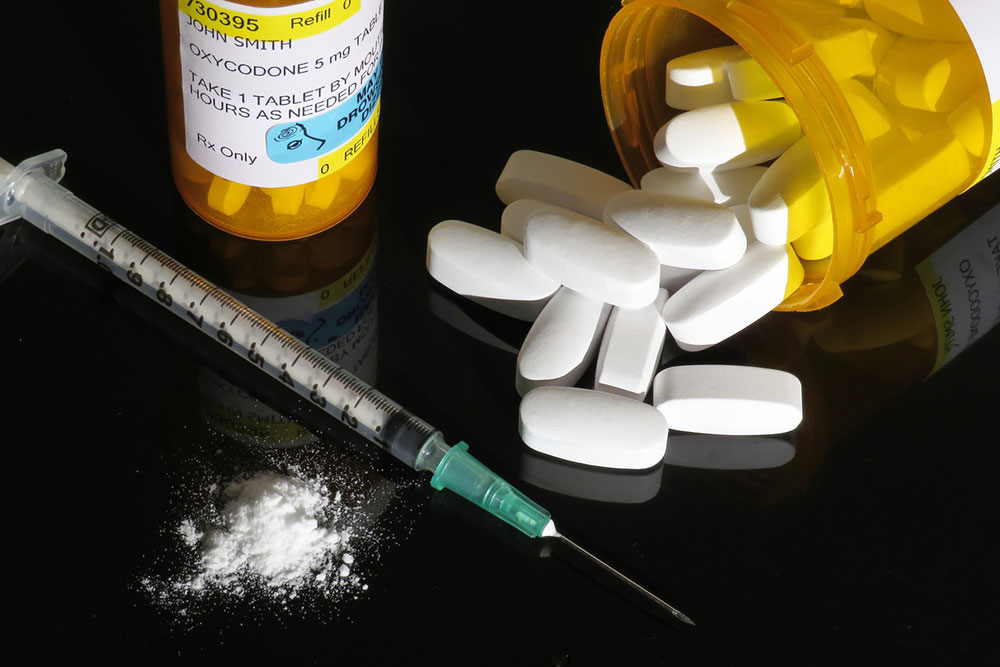
Image of opioids. Original image retrieved from here.
In the midst of the opioid epidemic, why are millions of Canadians turning to opioids for pain relief? One in four Canadians aged 15 or older live with chronic pain (Canadian Pain Task Force, 2020). A whopping 11,050,000 Canadians take opioids to manage chronic pain (National Center for Health Statistics, 2021).
Opioids bind to specific receptors in the brain and spinal cord to reduce pain perception (McDonald & Lambert, 2005). Pharmaceutical companies continue to leverage the need for long-term, pharmacotherapy interventions for chronic pain management. As a result, profits are very high. Whether chronic conditions or profits are the main drivers of mass medication production, the problem isn’t just a social one. Opioids have a significant environmental impact that only amplifies the need to address the crisis.
Environmental Concerns of Opioids
The current status quo for opioid production opposes UN Sustainable Development Goals for Life Below Water and Life on Land. The term “E-Factor” refers to the ratio of waste per unit of product (Sheldon, 2023). Pharmaceutical companies have E-factors between 25-100, which is worse than oil refining, bulk and fine chemicals industries (Sheldon et al., 2021).
Humans excrete opioids as opioid molecules in urine and feces, leading to soil and wastewater contamination (McDonald & Lambert, 2005). These lipophilic (“fat-loving”) molecules show low levels of biodegradation (Mazák et al., 2015). This means that they do not breakdown readily in the environment and instead persist. Researchers detected opioids downstream of wastewater treatment plants (Figure 1) (Herrero-Turrion et al., 2011). This raises concerns about potential effects on aquatic species. Studies show that fish can demonstrate addiction-like behaviours and withdrawal symptoms, when exposed to opioids (Herrero-Turrion et al., 2011). These current levels of contamination are unsustainable and pose significant environmental challenges (Campos-Mañas et al., 2018).

Figure 1. Impacts of water pollution from various sources on the environment. Examples of sources featured in the image include domestic uses, hospitals, and agriculture (Klimaszyk & Rzymski, 2018).
Sustainable Alternatives
Many patients find that pharmacotherapy pain management does not offer enough or any relief, and causes unwanted side effects. Thus, why don’t we consider other, non-pharmacotherapy options? Spinal Cord Simulation (SCS) therapy is a possible alternative.
Spinal Cord Stimulation (SCS) operates using a small rechargeable device called an electrical stimulator (Veizi et al., 2017). It is almost like a pacemaker for pain. The device sends electrical impulses to certain areas of the brain to alter the perception of pain (Sdrulla et al., 2018). Electrical impulses are signals that move along nerve pathways inside the spinal cord (Sdrulla et al., 2018). The modification of brain perception of pain is much like adjusting the volume on a radio (Iyer et al., 1998).
SCS is both easily accessible and environmentally sustainable. SCS depends on lithium-ion batteries. Recycling of the batteries is crucial for mitigating resource crises and protecting the environment (Blomgren, 2017).
Moving Forward
Despite the advantages, SCS struggles to gain mainstream media attention. Pharmaceutical companies hold significant political and economic influences because of the pharmaceutical industry’s massive revenue. Chronic pain sufferers believe they have no choice but to abuse prescription pills, propagated by pharmaceutical companies. Exploration and implementation of new strategies like SCS are essential to by-pass barriers to sustainable alternatives. These options can also provide users with more affordable, long-term and sustainable choices.
Pharmaceutical companies provided pivotal strides in pain management but we need more sustainable practices. Solutions must emphasize patient well-being and environmental health. Rethinking the reliance on prescription drugs will open the doors to a more environmentally sustainable future.
References
Blomgren, G. E. (2017). The development and future of lithium-ion batteries. Journal of The Electrochemical Society, 164(1), A5019. https://doi.org/10.1149/2.0251701jes
Campos-Mañas, M. C., Ferrer, I., Thurman, E. M., & Agüera, A. (2018). Opioid occurrence in environmental water samples—A review. Environmental Toxicology and Chemistry, 37(11), 3142–3151. https://doi.org/10.1016/j.teac.2018.e00059
Canadian Pain Task Force. (2020). Canadian Pain Task Force report. Health Canada. https://www.canada.ca/en/health-canada/corporate/about-health-canada/public-engagement/external-advisory-bodies/canadain-pain-task-force/report-2020.html
Herrero-Turrion, M. J., Sánchez-Simón, F. M., & Rodríguez, R. E. (2011). Opioids and opioid receptors in fishes. Encyclopedia of Fish Physiology from Genome to Environment, 2011, 89-97.
Iyer, R., Gnanadurai, T. V., & Forsey, P. (1998). Management of cardiac pacemaker in a patient with spinal cord stimulator implant. Pain, 74(2-3), 333-335.
Klimaszyk, P., & Rzymski, P. (2018). Water and aquatic fauna on drugs: What are the impacts of pharmaceutical pollution? In M. Zelenakova (Ed.), Water management and the environment: Case studies (pp. 257–272). Springer, Cham. https://doi.org/10.1007/978-3-319-79014-5_12
Mazák, K., Hosztafi, S., & Noszál, B. (2015). Species-specific lipophilicity of morphine antagonists. European Journal of Pharmaceutical Sciences, 78, 1-7.
McDonald, J., & Lambert, D. G. (2005). Opioid receptors. Continuing Education in Anaesthesia Critical Care & Pain, 5(1), 22–25. https://doi.org/10.1093/bjaceaccp/mki004
National Center for Health Statistics. (2021). Prescription opioid use among U.S. adults with chronic pain: National health statistics reports, number 162. Hyattsville, MD: Centers for Disease Control and Prevention. https://www.cdc.gov/nchs/data/nhsr/nhsr162-508.pdf
Sdrulla, A. D., Guan, Y., & Raja, S. N. (2018). Spinal cord stimulation: Clinical efficacy and potential mechanisms. Pain Practice, 18(8), 1048–1067. https://doi.org/10.1111/papr.12692
Sheldon, R. A., Bode, M. L., & Akakios, S. G. (2021). Metrics of green chemistry: Waste minimization. Current Opinion in Green and Sustainable Chemistry, 33, 100569. https://doi.org/10.1016/j.cogsc.2021.100569
Sheldon, R. A. (2023). The E factor at 30: a passion for pollution prevention. Green Chemistry, 25(5), 1704-1728.
Veizi, E., Hayek, S. M., North, J., Brent Chafin, T., Yearwood, T. L., Raso, L., … & Mekel-Bobrov, N. (2017). Spinal cord stimulation (SCS) with anatomically guided (3D) neural targeting shows superior chronic axial low back pain relief compared to traditional SCS—LUMINA Study. Pain Medicine, 18(8), 1534-1548.
About the Author
Gurdit is a first-year student in the Honours Integrated Sciences program at McMaster University. She has a strong passion for medicine and its impact. Alongside academic pursuits, she is a varsity softball player and enjoys playing a variety of sports.
 SCIFAA