
A “Chemical-Free” World?
“Chemical Free” label. Retrieved from this article.
I once saw a commercial on television that caught my attention. A commercial about a “chemical-free” vacuum said to eradicate all the woes of mediocre, competing vacuum brands. One problem. The vacuum operated on water.
Newsflash: Water is a chemical!
Living in a chemical-free society is impossible. Like, seriously impossible. So impossible that the Royal Society of Chemistry promised £1 million to any individual that could create a chemical-free product.1,2 Nope, it hasn’t been accomplished.
Living in a chemical-free world is physically impossible because water, a chemical, forms the basis of human existence. Aside from that, do you really want to live in a chemical-free world? Think about everything that you would be missing.
You know, like:
- The caffeine in your morning espresso.
- The polymers in the clothes that you wear.
- The chemicals that make flowers smell sweet.
- The sucrose that makes desserts taste great.
The list goes on.
Water: a Dangerous Chemical?
In 2023, a mother of two passed away after consuming four bottles of water in around 20 minutes.3 Too much water, too fast. She died from water intoxication, a condition that can lead to fatal swelling of the brain.4 In less severe cases, one experiences headaches, nausea and/or vomiting.4
Her story isn’t a one off. In 2007, Jennifer Strange lost her life to the “Hold Your Wee For a Wii” radio station contest.5 She drank six litres of water in three hours. A California State University student met a similar end from water intoxication in 2005, after participating in fraternity hazing.5
You wouldn’t consider water a dangerous chemical though, would you? As a general rule, water is not dangerous. Deaths from water intoxication are overall quite rare.4
Many chemicals, if used in appropriate quantities for intended uses, are not dangerous. In the paraphrased words of Paracelsus, “the dose makes the poison.”6 Water isn’t dangerous. Consuming four bottles in 20 minutes is dangerous. Coffee isn’t dangerous. Drinking 40 cups of coffee could be.7 Unless you intend to consume 83-500 apple seeds, the average apple will not give you cyanide poisoning.8,9
Yeah But What About the Other Chemicals?
Nonetheless, it is no secret that the harms of certain chemicals contributed to the anti-chemical sentiment that we witness today.
The 2010 Deepwater Horizon oil spill embodies the harm that toxic chemicals can have on environmental integrity.10,11 It is considered the largest offshore oil spill in United States history.10 The Deepwater Horizon oil rig exploded, releasing 134 million gallons of oil into the Gulf of Mexico.10,11 This resulted in the deaths or injuries of thousands of sea turtles, marine mammals, fish, etc., and claimed the lives of eleven men.10,12
Chemicals can harm human health, too. Some of these chemicals are alarmingly ubiquitous. The World Health Organization identified air pollution, cadmium, arsenic, and benzene as some chemicals of public health concern.13 Seven million premature deaths are annually linked to air pollution.13 This is because of increased levels of heart disease, lung cancer, stroke and respiratory illnesses.13 Cadmium is a carcinogen that especially threatens children, and is found in plastics, jewellry, and toys.13 Arsenic in drinking water is a continued problem in Bangladesh.13,14 Finally, the carcinogen benzene is a chemical common to petroleum products like motor fuels.13

WHO’s top ten chemicals of major public concern. Image retrieved from here.
So what’s to be done?
Green Chemistry: the Solution
Modern scientists must work to reduce or eradicate the environmental and social dangers of toxic chemicals. This can be accomplished via a widespread paradigm shift towards green chemistry.
Green chemistry describes “the design of chemical products and processes that reduce or eliminate the use or generation of hazardous substances.”15
This approach is defined by 12 principles of green chemistry. These rules range from real-time pollution prevention, to waste prevention, to energy efficiency. Many green chemistry principles overlap with the United Nations Sustainable Development Goals (UN SDGs).16 For example, UN SDG Goal 14 (Life Below Water) calls for reduced ocean acidification through scientific intervention.17 Ocean acidification is caused by the oceanic absorption of carbon dioxide from human sources.18 Since carbon dioxide is heavily produced by fossil fuel burning, chemists can seek more sustainable energy sources.18 This is equally beneficial to tackling UN SDG Goal #7 (Affordable and Clean Energy)!17 Reduced fossil fuel usage means increased dependence on non-finite, emissionless and cleaner energy sources.
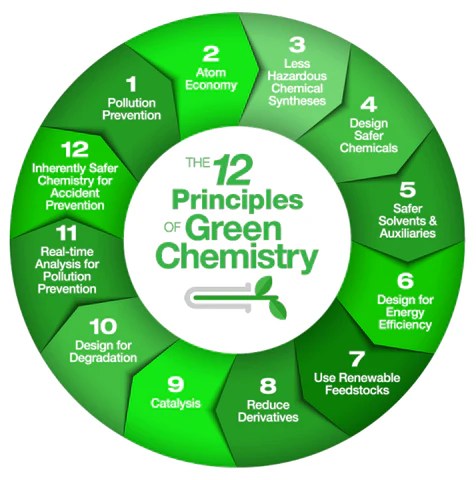
12 Principles of Green Chemistry. Image retrieved from here.
Chemists are applying green chemistry principles with encouraging results. University of Michigan’s Dr. Richard Laine won the 2023 Green Chemistry Challenge Academic Award.19 He developed a method to convert agricultural waste into silica-based materials usable in lithium-ion batteries. Another 2023 Green Chemistry Challenge winner, Solugen, is challenging the need for fossil fuel dependent manufacturing processes. The team’s platform, Bioforge™, depends on renewable resources and can offer high performance detergent or water treatment applications.20
Universities are also working to ensure university chemistry students are trained in green chemistry principles. McMaster University is the only Canadian university that offers a Bachelor of Applied Science in Sustainable Chemistry. Likewise, the University of Toronto’s Green Chemistry Institute is a student-run organization committed to green chemistry outreach and education. To learn more about academic efforts to teach green chemistry, check out these articles by the UoFT Green Chemistry Institute.
It’s time to change the narrative!
References
1Are chemical free products real?. Eurofins. (n.d.). https://sustainabilityservices.eurofins.com/news/are-chemical-free-products-real/#:~:text=It%20is%20impossible%20to%20make,potentially%20spurious%20and%20or%20greenwashing
2£1million bounty offered for UK’s first chemical-free product. The Royal Society of Chemistry. (2010, February 23). https://www.rsc.org/news-events/articles/2010/02-february/chemical-free/
3Holohan, M. (2023, August 14). Family raises awareness after mom of 2 dies from water intoxication on vacation. Today. https://www.today.com/health/news/water-intoxication-death-rcna99472
4Semeco, A. (2023, December 19). What happens if you drink too much water?. Medical News Today. https://www.medicalnewstoday.com/articles/318619
5Ballantyne, C. (2007, June 21). Strange but True: Drinking Too Much Water Can Kill. Scientific American. https://www.scientificamerican.com/article/strange-but-true-drinking-too-much-water-can-kill/
6“The Dose Makes the Poison.” Chemical Safety Facts. (2022, August 17). https://www.chemicalsafetyfacts.org/health-and-safety/the-dose-makes-the-poison/
7Wang, C. (2022, August 26). How Many Yerbas Does It Take to Overdose on Caffeine?. McGill University. https://www.mcgill.ca/oss/article/health-and-nutrition-you-asked/how-many-yerbas-does-it-take-overdose-caffeine#:~:text=A%20lethal%20amount%20of%20caffeine,of%20coffee%20to%20be%20lethal
8Arnarson, A. (2024, February 16). What happens if you eat apple seeds?. Medical News Today. https://www.medicalnewstoday.com/articles/318706
9Skinner, R. C., Gigliotti, J. C., Ku, K.-M., & Tou, J. C. (2018). A comprehensive analysis of the composition, health benefits, and safety of apple pomace. Nutrition Reviews, 76(12), 893–909. https://doi.org/10.1093/nutrit/nuy033
10Deepwater Horizon: Effect on Marine Mammals and Sea Turtles. NOAA’s National Ocean Service . (2017, April 20). https://oceanservice.noaa.gov/news/apr17/dwh-protected-species.html
11Deepwater Horizon – BP Gulf of Mexico Oil Spill. U.S. Environmental Protection Agency . (2024, July 24). https://www.epa.gov/enforcement/deepwater-horizon-bp-gulf-mexico-oil-spill
12Deepwater Horizon | Oil Spills |. NOAA’S Damage, Assessment, Remediation, and Restoration Program. (2022, October 5). https://darrp.noaa.gov/oil-spills/deepwater-horizon
13World Health Organization. (2020, June 1). 10 chemicals of public health concern. World Health Organization (WHO). https://www.who.int/news-room/photo-story/photo-story-detail/10-chemicals-of-public-health-concern
14Paddison, L. (2024, March 22). Tens of millions of people in this country drink arsenic-contaminated water. It could get a lot worse. CNN. https://edition.cnn.com/2024/03/21/climate/arsenic-contaminated-water-bangladesh-climate-intl/index.html
15U.S. Environmental Protection Agency. (2024a, May 2). Basics of Green Chemistry. https://www.epa.gov/greenchemistry/basics-green-chemistry
16The 17 Goals | Sustainable Development. United Nations (n.d.). https://sdgs.un.org/goals
17Oceans – United Nations Sustainable Development . United Nations. (n.d.). https://www.un.org/sustainabledevelopment/oceans/
18Ocean Acidification Definition and Causes: An In-Depth Exploration. College of Life Sciences and Agriculture | University of New Hampshire. (2023, December 6). https://colsa.unh.edu/blog/2023/12/ocean-acidification-definition-causes-depth-exploration#:~:text=It%20refers%20to%20the%20decrease,makes%20the%20ocean%20more%20acidic.
19U.S. Environmental Protection Agency. (2024b, October 22). Green Chemistry Challenge: 2023 Academic Award. https://www.epa.gov/greenchemistry/green-chemistry-challenge-2023-academic-award
20Green Chemistry Challenge: 2023 Greener Synthetic Pathways Award. U.S. Environmental Protection Agency. (2024, October 22). https://www.epa.gov/greenchemistry/green-chemistry-challenge-2023-greener-synthetic-pathways-award
About the Author
Yasmin is a McMaster University graduate and Program Coordinator at SCIFAA. She holds a Bachelor of Applied Science in Sustainable Chemistry and a Minor in Environmental Sciences.
 SCIFAA