
A Perspective from the ACS Sustainability Summit: Reimagining Chemistry Education.
Goal of the Summit
The summit focused on reimagining chemistry education to include green chemistry and sustainability in the curriculum. Educators and stakeholders held several panel discussions. These discussions aimed to create a long-lasting educational synergy that will advance the field of chemistry in the right direction. This includes considering societal and environmental issues when developing new “chemistries.”
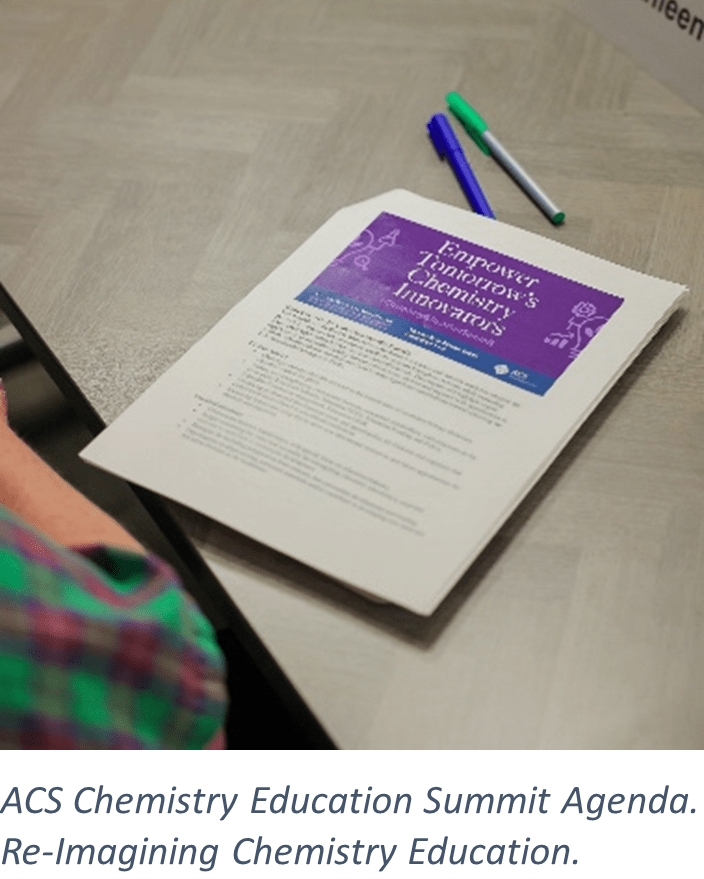
Re-Imaging Chemistry Education
The event started with a thought exercise around this question: How do we re-image chemistry education? Some of the voiced ideas concerned improved student engagement by relating curriculum topics to global issues that impact them directly. Others claimed that we should include green and sustainable education topics from a younger age (e.g., grades K-12). My personal opinion is to re-imagine science, rather than chemistry, and the connections beyond. We tend to forget how scientific advances and new technologies impact our society in realms like law, economics and politics. The chemistry curriculum developed >100 years ago has not evolved to reflect modern times and impacts of society on society. For instance, consider the environmental impact of anthropogenic nitrogen (e.g., Haber-Bosch process and its relation to fertilizer production). This could easily be integrated in lectures covering the gas laws, illustrating the broader implications of chemistry processes.
How do we re-imagine the chemistry curriculum?
Something I have realized through my teaching duties is that it can be uncomfortable to teach or explain something one does not fully understand. I think that this issue lies in the teaching standards that we have in academia. When faced with difficult questions, academics are expected to know all the answers. Showing hesitation or uncertainty is seen as a weakness. Nonetheless, it is beneficial to both the student and teacher to take time to reflect. This allows them to come back with a more informed and precise answer in a future lecture. Science is based on the premise that there are many things that we are uncertain about. Thus, being uncertain about a topic should not be seen as a flaw. Rather, it is a teaching opportunity to shows how the tools and knowledge we have can help solve complex challenges.
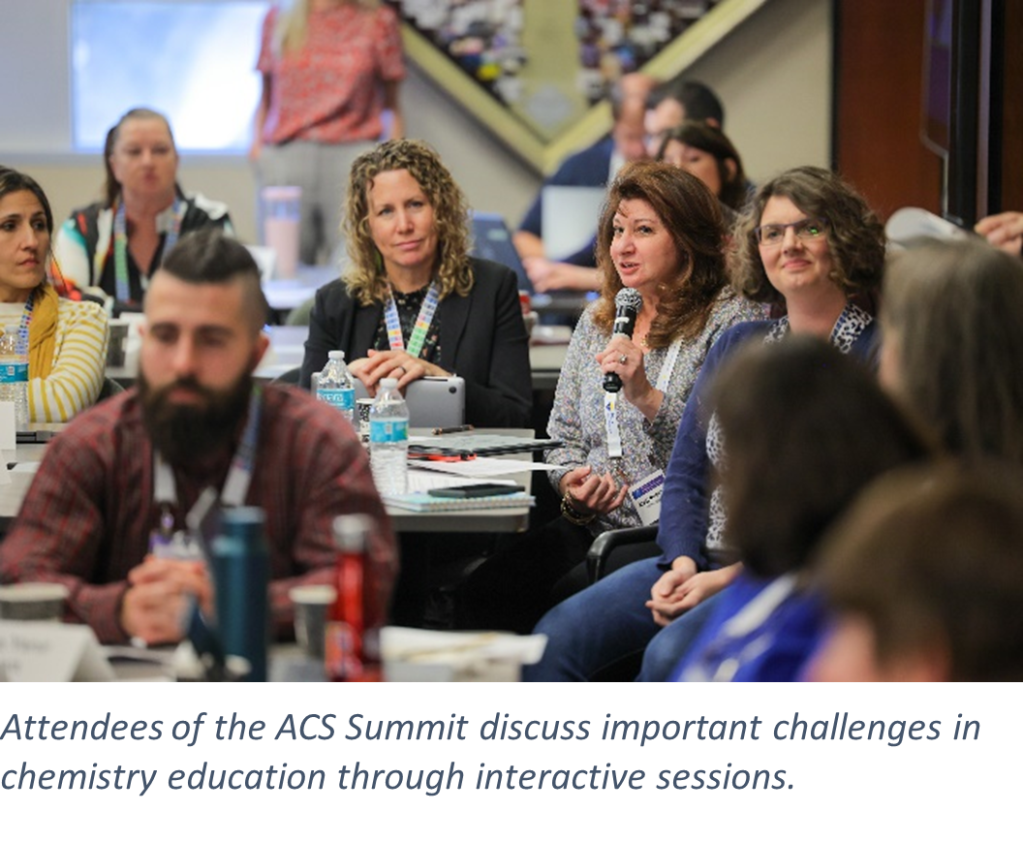
To help bridge this confidence gap in teaching, the Green Chemistry Institute at ACS (ACS GCI) and instructors from 45 institutions developed new teaching modules for the chemistry curriculum. These were presented at the Summit. These modules serve as tools for educators to help them integrate green and sustainable chemistry in the classroom. These also help establish connections between the topics and global challenges. These modules are freely available on their website.
I hope that the use of these modules will rapidly increase as more educators come on board. This will increase teacher’s confidence in green chemistry and eventually translate into behaviour change to permanently improve the chemistry curriculum. This is what we need ultimately to create meaningful change in the right direction.
Why do we care about green chemistry and sustainability?
This is another question that sparked fruitful discussions at the Summit. At a first glance, the primary goal of green chemistry is to enable solutions to environmental issues. Yet, because these issues are intricately intertwined with broader societal challenges, our impact is felt in other global issues.
Chemistry can have significant societal implications, like on environmental justice, which was discussed at the Summit. The inclusion of such topics in the curriculum will be essential to engage and connect students to the global context. Chemists, scientists and people from all backgrounds and locations globally must be educated and included to tackle global issues. This will allow us to include different perspectives on particular issues. Only then will we have the tools, knowledge, and understanding to harmoniously approach these big challenges.
What is the connection between education and industry?
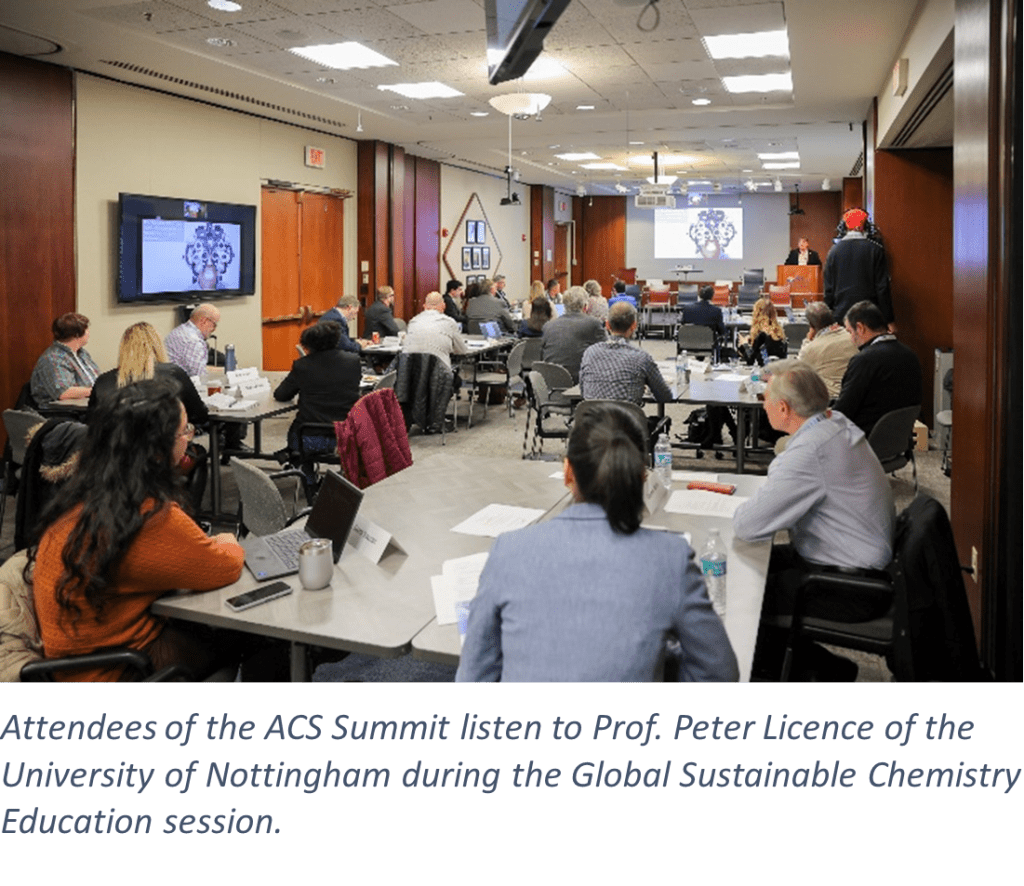
Global environmental issues have urged industries to adopt greener and more sustainable practices. Hence, fresh knowledge is required from the incoming workforce to tackle these new pressing challenges. An entire panel at the Summit focused on bridging industry and academia in this regard. The educational gap that disconnects industry from academia is also because the chemistry curriculum has not been updated in decades. This translates into a lack of skills to approach the shifting world. This includes little awareness on available tools to help chemists tackle global challenges. As students, we must advocate for a system change regardless of our career goals. This is especially true for chemists because of the direct implications of our work towards humans and the environment. Once a system change is achieved, we will be well equipped to make the world a better place.
Most of the discussions revolved around re-imaging education at the high school and undergraduate levels. This encompasses a large percentage of students. Nonetheless, there is a knowledge gap when we look at students that are currently in graduate school (like myself) and who are about to join the workforce. These students have never received proper green and sustainable chemistry education/training. Graduate students need an immediate intervention in their education through free and accessible resources including courses and workshops. These initiatives will aid in filling in those missing skills and knowledge which are required in this changing world. In-house Green Chemistry Initiatives are essential to fill this gap and to preserve/foster the incoming green chemistry knowledge from undergraduates.
We (the UFT GCI) are developing a one-day green chemistry educational workshop for graduate students in collaboration with Beyond Benign. This interactive workshop aims to review graduate students will need for industry jobs. This also includes tools and knowledge on how to use available resources (e.g., solvent selection guides) for green chemistry research. We will also cover how to include green chemistry in teaching duties (e.g., undergraduate tutorials) and how to approach a supervisor to discuss green chemistry research avenues. This hybrid event is scheduled to run for the first time this spring. It will be free of charge and open for international registration (see our website for more information).
Concluding remarks
We are facing unprecedented climate and societal crises but we are not prepared to address this. I strongly believe that a major educational transformation to include topics in green chemistry and sustainability is key. This will create a paradigm shift towards more environmentally conscious science. Education is the basis of all human actions and behaviours. Thus, a disruptive change in the educational system is needed to upset the chaos generated by people making ill-informed decisions.
About the Author
Francisco Yarur Villaneuva is a Graduate Student at the University of Toronto and was one of the 2023-2024 Co-chairs of the Green Chemistry Initiative at the University of Toronto. To read more articles from the UoFT GCI, click here.
 SCIFAA