

The 2024 ACS GCI Summer School Cohort!
This past June, I attended the 2024 ACS GCI Green & Sustainable Chemistry Summer School at the University of Vermont (UVM). It was an intense but very rewarding six days, packed with lectures and workshops. At night, we attended poster sessions or worked on homework/projects for the next day! There is so much to talk about from Summer School. I could easily write 4-6 blog posts and still not cover everything! Nonetheless, I will try to highlight some of the key things I learned.
Fun Fact: The government of Vermont declared June 21st-26th, 2024 “Green Chemistry Week” as a nod to the summer school being held at UVM for the first time!
Day One: Introduction & Overview
The day kicked off by the man himself, Dr. John Warner. Dr. Warner is one of the co-creators of the 12 principles of green chemistry. He delivered an inspiring talk about his experiences which led to a lifelong advocacy to change our approach to chemistry. He spoke a lot on how the field of green chemistry has evolved and why this matters so much today. Dr. Amy Cannon followed up with a discussion on her experiences and pursuit of a Green Chemistry doctorate (the first in the field)! She also highlighted the work done by Beyond Benign. We then got to meet the entire cohort, which led by Dr. Adelina Voutchkova! We did some introductions and it was really great to hear everyone’s experiences. We learned about how we all came to care deeply about sustainability. We rounded everything off by doing some self-assessments to set personal goals for the week.
Day Two. Designing Safer Chemicals for Healthy Communities
We attended a series of lectures about assessing toxicity and the environmental impacts. We began with an informative talk from Dr. Sederra Ross on environmental justice, a key concept in green chemistry. She highlighted that marginalized communities have historically been most affected by toxic waste from chemical production and/or toxic end products. Then, Prof. Heater Buckley showed us how to assess hazard and exposure using online tools and databases. One example is PHAROS, which is a paid-database that contains hazard information on many different chemicals. Another is a free-tool from the US EPA called the EasyRSEI. We also got our main group project assignments that day!

Dr. Edmond Lam’s presentation on sustainable feedstocks.
Day Three: Sustainable Synthesis & Manufacturing
We attended lectures on making labs greener from Prof. Phil Jessop. This include content on how to evaluate the environmental impact of synthetic processes using Life Cycle Asessments (LCAs). We also got to practice calculating LCAs on our own and identifying hotspots! Dr. Isamir Martinez then introduced us to some important metrics for measuring how “green” our syntheses are. These tools are all available on the ACS GCI Pharmaceutical Roundtable’s website. Some tools include the Solvent Selection Tool and Process Mass Intensity (PMI) Calculator. And they’re always coming out with new tools! I also appreciated how Dr. Martinez spent time talking about her experiences as a scientist both in academia and industry.
Day Four: Break Day!
This was an excursion day. The group had a morning hike and boat ride on Lake Champlain! Unfortunately, I got the bug so I could not go to the group activities 😦 But, I did get to explore the city of Burlington a little when I felt better!
Day Five: Greener Synthesis Toolbox
We talked about catalysis and how it can contribute to the circular economy. Circular economy is a really helpful way to see exactly how our work as researchers impacts the world outside of the lab. Prof. Rory Waterman delivered a great talk on this. We also covered greener solvents and how to implement them into our research. This tied directly into the group projects we had been working on, a workshop led by Dr. Phil Jessop again. Dr. Edmond Lam then provided insight on using renewable feedstocks for synthesis. Fun fact: Dr. Lam is a UofT alumnus and spent time working as scientist for the Canadian government!

With the ACS GCI Team at the Closing Banquet
Day Six: Wrap Up
The final day focused on putting everything into action. Prof. Tova Williams delivered an academic lecture on sustainable dyes and textiles, a really cool and important topic! We also listened to a professional development talk by Dr. Joerg Schlatterer from the ACS. Finally, we held our main project presentations, which I will talk more about below.
Working Together
Group projects consisted of a huge part of the experience. This year, we were assigned groups before the summer school started. Each group had to prepare a poster on a green synthetic too. My group worked on Phase Transfer Catalysis, a method to improve reaction efficiency by moving reactants and products between phases. This helps reduce the amount of toxic solvents used in the reaction. You can check out our poster on the Green Chemistry for Sustainability platform! It was a great way to meet the rest of the group and get into the green chemistry mindset before stepping foot in Vermont. Of course, we should always be in the green chemistry mindset!
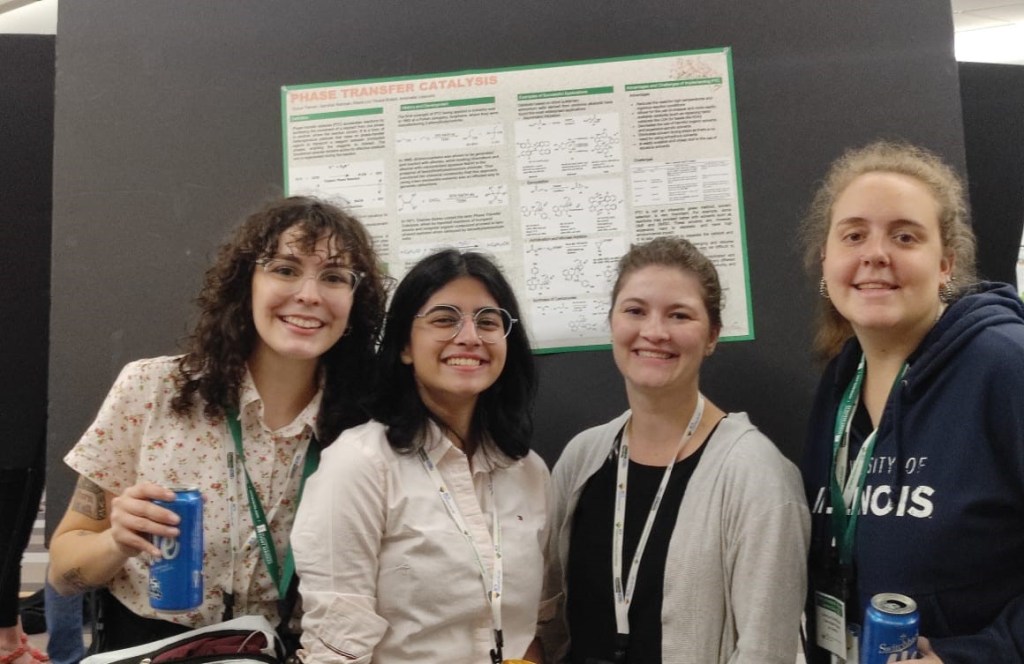
The PTC group in front of our poster at the end of Day 1!
Our main project involved assessing the entire lifecycle of the chemical. This included how the chemical is made and how it affects the environment. My group focused on the chemical chloroprene, a monomer used to make the synthetic rubber, neoprene. It is known to have toxic impacts on the environment/human health. It has also significantly affected communities in the South U.S., where production facilities are located. We used tools like PHAROS and computational models to analyze its toxicity and historical impact on key communities. Throughout the week, we learned about a bunch of different ways to make synthetic processes greener. This definitely helped guide our project and allowed us to offer alternative options for synthesis and potential substitute materials.
By the end of the week, we had a short 3-5 minute presentation to share our findings. This was a lot of work! We definitely stayed up some nights be we also learned a lot of valuable information. The eye-opening experience allowed us to see how vigorous hazard and risk assessments can be for a single molecule! I enjoyed working in groups and bouncing ideas off one another to develop solutions as a team. I really appreciated having such a diverse cohort. The group had students from across the Americans and the Caribbean so we all had a different perspective. It created an excellent learning environment.
Apply for next year’s summer school!
The 2024 ACS GCI Summer School allowed us to dive deeper into green chemistry principles. We had a great time learning to apply them to real-world issues. The experience was incredible between group projects, lectures, and getting to connect with passionate students. I will not forget how great it felt to be around like-minded people who care about sustainability and want to improve the world. I want to thank the ACS GCI team for hosting such a wonderful week. Special shout-out to Dr. David Laviska and Cecilia Smith for their great hospitality! If you are a graduate student or post-doc interested in sustainability/chemistry, I definitely recommend applying for next year’s program! The application will be open November-January and the program is fully-funded by the ACS GCI (including all travel and accommodations).

Let’s go Green Chem!
About the Author
Samihat Rahman is the co-chair of the Green Chemistry Initiative at the University of Toronto. To read more articles from the UoFT GCI, click here.
 SCIFAA