
South Korea will host the final negotiations for the Global Plastics Treaty, at the end of November. Past negotiations have produced very few decisive outcomes about the Treaty. This meeting will be crucial in deciding how the international community must tackle the issue of plastic pollution. From cutting production of primary plastics to improving recycling infrastructure, different actions will be considered in the final treaty version. The plastic industry and some governments are more focused on downstream solutions like collection of plastics for recycling and cleanups. The High Ambition Coalition to End Plastic Pollution (which includes Canada) hopes to reduce sources of harmful and unnecessary plastics.
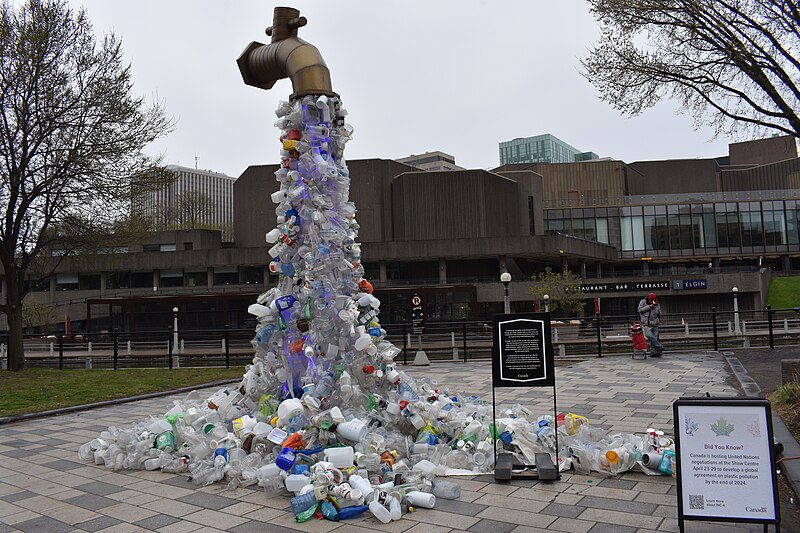
Abstract art piece. A tap floating in the air with an enormous amount of plastic waste flowing out onto the sidewalk.
Stakeholders across the globe will need to collaborate in meaningful ways to ensure that everyone achieves the Treaty’s objectives. There are significant differences in capacity and resources available to each government to make changes required by the Treaty. Economically developed countries are highly responsible for most plastic produced for single-use and short-life consumption, and environmental plastic litter. This means they play key roles in working with other parties to create supports and systems to end plastic pollution.
Three key ways to collaborate under the Treaty:
Technical capacity and knowledge sharing
According to a recent OECD report, infrastructure must be scaled up to reduce plastic leakage globally. In particular, waste management in less economically developed countries must be enhanced to tackle plastic pollution. These countries heavily rely on informal waste management practices and so, waste collection rates are extremely low. This is worsened by highly economically developed countries sending massive quantities of their unwanted plastic waste to countries without adequate infrastructure.
As research is conducted and new recycling processes established, findings must be shared with all countries to maximize global impact. This will need the economically developed countries to provide technical and operational assistance to others with limited capacity.
Financial resources and burden sharing
Cooperation is essential to counteract the uneven geographical distribution of costs to end plastic pollution. The World Wildlife Fund suggests that the lifetime cost of plastic is 10.6 times higher in low income countries than it is in high income countries. Less economically developed countries usually face more complex barriers to plastic pollution reduction, including Pacific and small island developing states. This is different from the wealthier countries which have the investment capacity to shift to a circular economy model. The investment requirements to expand and develop truly successful waste management systems in non-OECD countries would be expensive. This would cost over USD 1 trillion across 20 years. This is based on a projected global policy framework expected to truly tackle plastic waste.
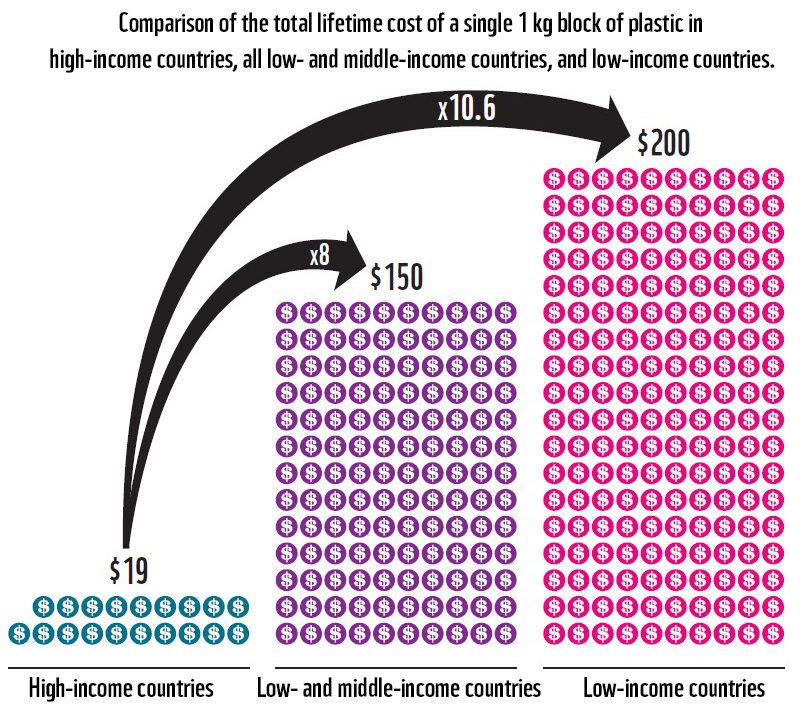
High income countries: $19, Low and middle income countries: $150, Low income Countries $200
Clearly, costs of taking action against plastic pollution should not solely be the burden of less economically developed countries. The financial responsibility of adopting new policies and making investments in advancing waste management systems will fall to these countries. These are the same communities most affected by plastic pollution, including adverse impacts on tourism, local fisheries and human well-being. Yet, they are faced with the daunting task of changing their waste systems to accommodate an issue they often did not create. Financial collaboration is key to removing these barriers to meaningful solution-building and participation in the Treaty.
There are several pathways to mobilizing further investment for the reduction of global plastic pollution, as outlined by the OECD:
- Support initiatives to scale up total resources available, particularly from the private sector.
- Allot existing funding according to developed targets, country needs, and priorities.
- Foster innovation and international best practices.
- Promote mutual learning and developing guidance for more effective collaboration.
Global collaboration to ensure treaty is fair and equitable
Governments globally have already done the difficult work of uniting to agree that plastic pollution must be tackled urgently. They must continue to focus on collaboration, so that no one gets left behind. Plastic pollution will not be addressed if action is limited to specific countries with existing capacity to move forward. Many highly economically developed countries played a large role in contributing to the problem. They shipped plastics to countries without the infrastructure or financial means to deal with the consequences of waste. Corporations must also play a role. They’ve expanded the single-use market and created demand for plastics without considering successful end-of-life management.
Where do we go from here?
A global treaty is only as effective as its members’ commitments to the objectives. There is no one solution for the plastic pollution crisis. Governments and stakeholders must engage on all fronts to take action and acknowledge their contributions to the issue. Collaboration is necessary to develop an equitable transition away from plastic pollution. Only through collaboration can we have the chance to share resources, capacity and knowledge of plastic pollution elimination.

UN delegates come together in the name of global treaties against plastic pollution
We’re interested to see how the Treaty will take shape in the coming months. It would be most beneficial for governments and stakeholders to work collectively to agree on upstream interventions for plastic pollution. Fair and equitable participation from all parties across collaborative structures is also key. Stay tuned for more updates on the Treaty and other collaboration opportunities to end plastic pollution!
To learn more about the OECD’s Policy Pathways to 2040, read their most recent report here.
About the Author
Michelle Brake is the Program and Policy Manager at Mind Your Plastic (MYP). She holds a bachelor’s and a master’s degree in political science from Wilfrid Laurier University in Waterloo, Ontario. Learn more about Michelle here!
 SCIFAA