
Though visually appealing, almost all glitter used by humans poses a significant environmental problem due to long-term persistence of microplastics. A new formulation by a University of Cambridge group addresses this problem. The new formula is based on cellulose polymers from plants and is just as shimmery as the original product.
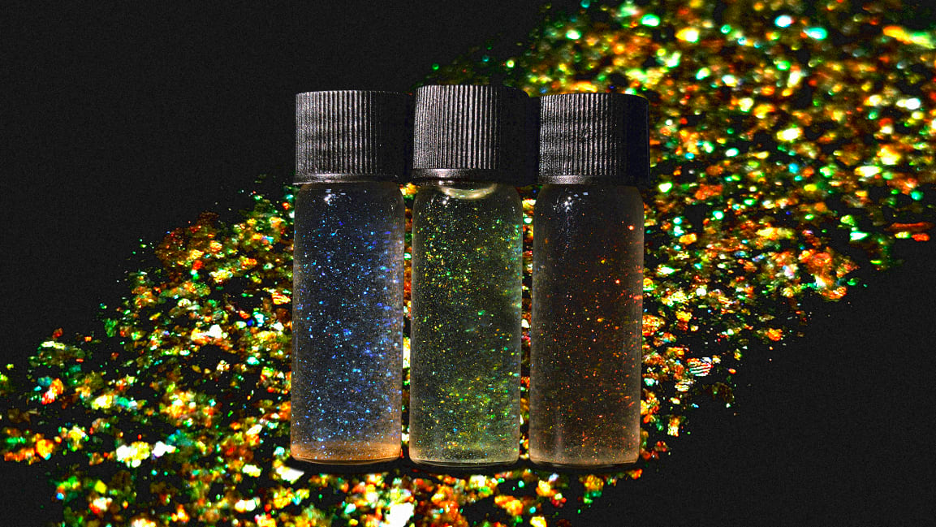
Figure 1. Cellulose nanocrystal structures are pictured in three different media from left to right (water, a water/ethanol mixture and ethanol). Colour differences are observed due to differences in water-uptake and swelling that causes red-shifting of the coloured particles. Figure taken from reference 2.
Everyone will use glitter at some point in their lives, especially for arts and crafts. We can probably all relate to the impossibility of cleaning up these small, shimmery pieces of plastic. Perhaps a lesser known fact, glitter can be a toxic and unsustainable material that contributes to the global plastic problem.
Glitter used in cosmetic products is inevitably washed off, resulting in the microplastic pieces ending up in water bodies. Efforts to reduce this problem with existing plant-based glitters have struggled to achieve full sustainability. This is because aluminum or plastic films are needed to generate the signature, shimmery effect. In Europe alone, the cosmetics industry is responsible for producing over 5500 tones of microplastic every year. This is a current and significant problem.
Researchers at the University of Cambridge have been working to solve the issue. The team published an article in Nature Materials on using cellulose-based glitter as a safer choice without comprising visual appearance.¹ The group produce glitter from cellulose, successfully extracting and producing materials from wood-pulp, cotton and mango peels. Cellulose is the main building block of cell walls in plants, fruits and vegetables. In fact, since the glitter is only made from cellulose, it is safe to eat.
The glitter consists of cellulose nanocrystals. These nanocrystals are microscopic structures that can bend light to produce vivid colours, known as “Structural Colour.” The same phenomenon can seen across nature. For example, the bright colours of butterfly wings and peacock feathers are produced through this effect through light interactions. The nanocrystals similarly arrange in a helicoidal structure, meaning that the layers rotate in a spiral pattern like a staircase.
These structure can be modified to produce different colours, based on the distances between the “stairs” in the helicoidal structure. The larger the features, the longer the wavelengths of light that get reflected. This can majorly affect the observed colour. Also, viewing angle, distance and liquids used for dispersions can affect light interaction, leading to different colours. The resulting hues from this colour formation do not fade over time, even after hundreds of years.
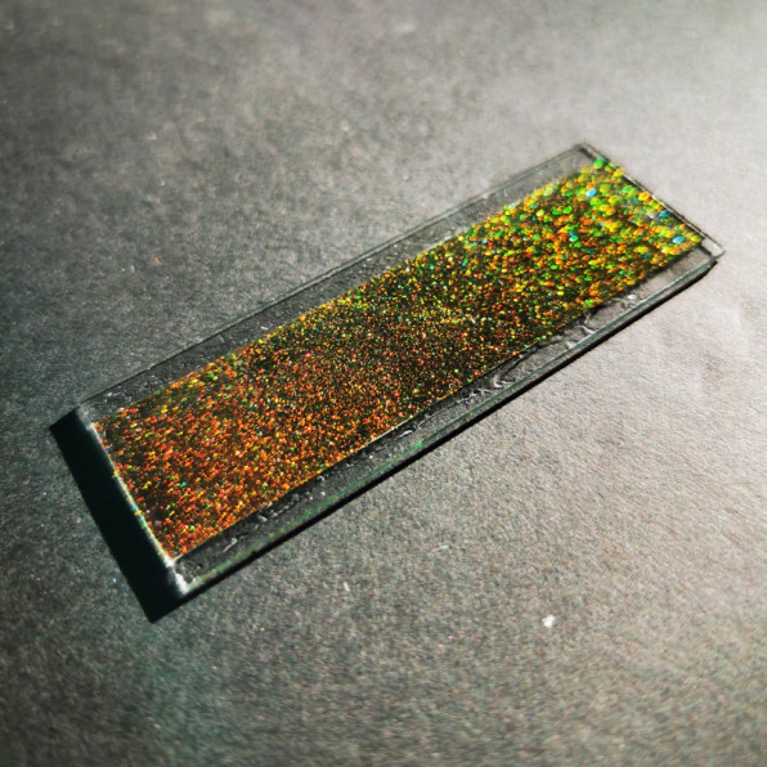
Figure 2. Cellulose nanocrystal on glass slide showing different colours based on angle of viewing and incident light. Figure taken from reference 3.
Cellulose nanocrystal films can be mass-produced using roll-to-roll processes, like those used in wood pulp processing to make paper. This process of spontaneous formation of cellulose nanocrystal structures is called “Self Assembly.” Specifically, this is when helical twisting occurs, aligning the crystals for colour production.
The team optimized the roll-to-roll process to create large-scale cellulose films by packing cellulose into water to cause swelling. As water evaporates, the cellulose film contracts and shifts into a the spiraling, light reflecting colours desired. This film can be easily ground into tiny particles that resemble glitter. Most importantly, these biodegradable particles are completely free or plastic and toxins. This method is far less energy intensive that conventional approaches used in current production.
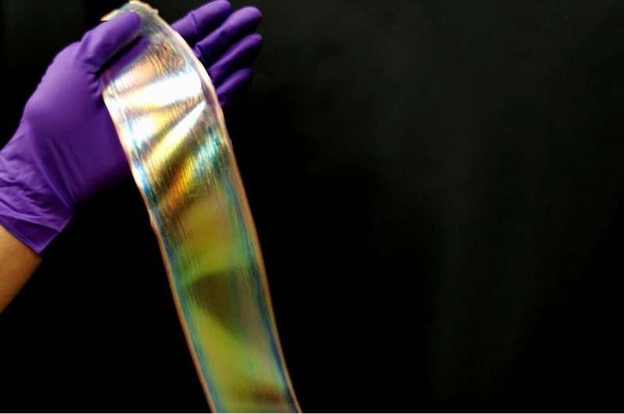
Figure 3. Cellulose film produced by roll-to-roll process. Figure taken from reference 2.
The next steps are to scale up production into commercial and industrial sized equipment, for market use in upcoming years. The use of theses sustainable glitter particles is a revolutionary discovery. There is great potential for large-scale usage even in the cosmetic industry. This could significantly reduce global microplastic production, leading to a safe and sustainable future thanks to Material Chemists!
The findings of this research has been published in the Journal of Nature Materials:
Droguet, B. E.; Liang, H.-L.; Frka-Petesic, B.; Parker, R. M.; De Volder, M. F. L.; Baumberg, J. J.; Vignolini, S. Large-Scale Fabrication of Structurally Coloured Cellulose Nanocrystal Films and Effect Pigments. Nat. Mater. 2021 2021, 1–7. DOI: 10.1038/s41563-021-01135-8. www.nature.com/articles/s41563-021-01135-8.
References
¹Droguet, B. E.; Liang, H.-L.; Frka-Petesic, B.; Parker, R. M.; De Volder, M. F. L.; Baumberg, J. J.; Vignolini, S. Large-Scale Fabrication of Structurally Coloured Cellulose Nanocrystal Films and Effect Pigments. Nat. Mater. 2021 2021, 1–7.
²https://www.fastcompany.com/90695646/this-new-biodegradable-glitter-is-made-entirely-from-plants. (accessed Nov 15, 2021).
³https://phys.org/news/2021-11-sustainable-biodegradable-vegan-glitterfrom-fruit.html.(accessed Nov 15, 2021).
About the Author

MUSCS
The McMaster Undergraduate Society for Chemical Sciences (MUSCS) is a student-run organization dedicated to enhancing the undergraduate experience for all McMaster University Chemistry & Chemical Biology Students. You can check out their Instagram page here.
 SCIFAA